How San Diego Solar Reduces Gas to Electric Cost in 2026
How Solar Reduces Gas to Electric Cost in 2026

Solar energy reduces gas to electric cost by generating free electricity that directly offsets what you would otherwise buy from your utility at peak rates. The industry term for this is solar self-consumption, and it is the core mechanism behind every dollar you save. When you add electric appliances, an EV, or a heat pump to a solar-powered home, you replace volatile gas and utility spending with electricity you already own. Understanding how solar reduces gas to electric cost is the first step toward locking in predictable energy bills for the next 25 years.
How solar reduces gas to electric cost: the real financial picture
Solar energy savings are not abstract. The average U.S. homeowner saves $35,000 to $65,000 over 25 years, with a payback period of 6 to 12 years and annual savings of $1,200 to $2,000. That range reflects differences in system size, local utility rates, and how aggressively you electrify your home.
The savings grow over time because utility rates rise roughly 3–4% annually. Every year your solar panels produce the same amount of electricity, that electricity is worth more against a rising utility rate. A flat-rate estimate of your 25-year savings actually understates the real number because it ignores compounding. Homeowners who install solar in 2026 are locking in today’s production cost against tomorrow’s higher rates.
Here is a simplified view of how solar savings stack up over time:
| Timeframe | Estimated Cumulative Savings |
|---|---|
| Year 1 | $1,200–$2,000 |
| Year 5 | $6,500–$11,000 |
| Year 10 | $14,000–$24,000 |
| Year 25 | $35,000–$65,000 |
Estimates based on national averages. San Diego homeowners with SDG&E rates typically land at the higher end of these ranges.
Key factors that determine where you fall in that range:
- System size relative to your load. A system sized too small leaves money on the table. A system sized to cover 100% of your projected electric load, including electrified appliances, captures the full benefit.
- Utility rate structure. SDG&E’s time-of-use rates are among the highest in the country. That makes solar more valuable in San Diego than in most U.S. markets.
- Whether you add storage. Battery storage captures solar energy you would otherwise export at low credit rates and uses it during expensive evening peak hours.
Pro Tip: Before you get a solar quote, pull 12 months of SDG&E bills and calculate your average monthly kilowatt-hour usage. A system sized to your actual consumption, not a neighbor’s, delivers the fastest payback.
How does solar plus storage compare to natural gas costs?
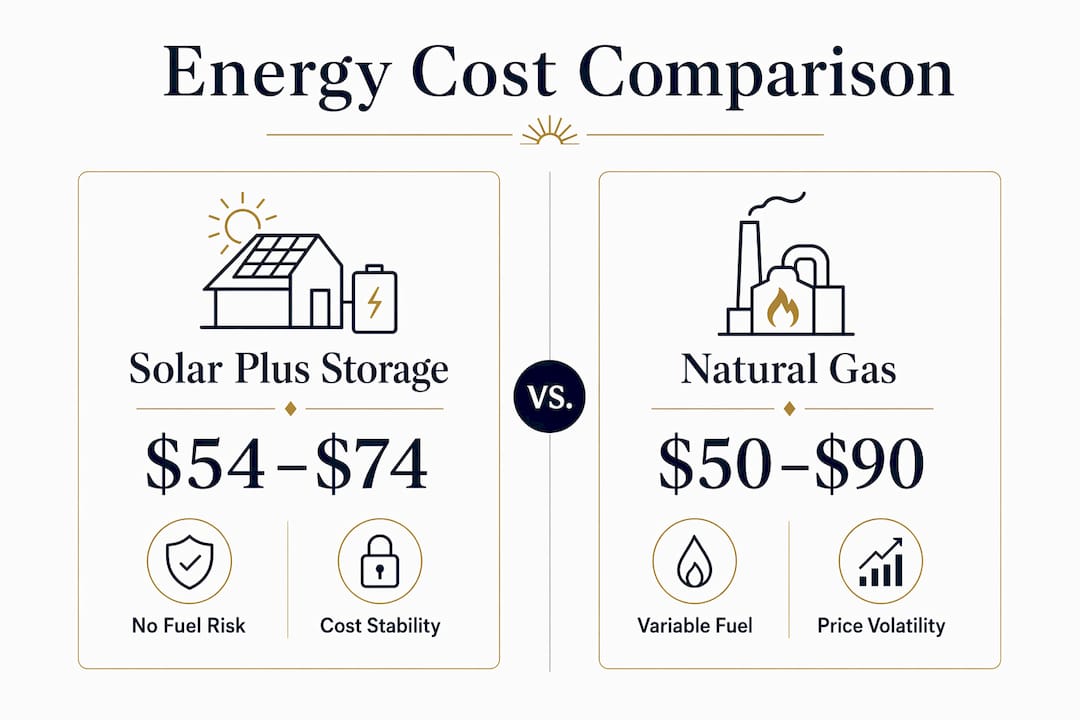
The standard way to compare energy sources is the levelized cost of energy, or LCOE. LCOE measures the total lifetime cost of producing one megawatt-hour of electricity. Firm solar plus storage now costs $54–$74 per MWh. New combined-cycle gas turbine plants cost $60–$95 per MWh. Solar with a battery is now cheaper than building new gas generation, and that gap is widening.
What makes this comparison meaningful for homeowners is the concept of firm power. Gas plants are dispatchable, meaning they produce electricity on demand at any hour. Solar alone is not. But solar paired with a Tesla Powerwall, Enphase IQ battery, or Franklin WH system becomes firm power. You store midday solar production and deploy it at 7 p.m. when SDG&E rates peak. That is the same economic logic utilities use, applied at the home level.

| Energy Source | LCOE (per MWh) | Fuel Cost Risk |
|---|---|---|
| Solar plus storage | $54–$74 | None (sunlight is free) |
| Combined-cycle gas plant | $60–$95 | High (global gas markets) |
| SDG&E retail rate (peak) | $150+ | High (rate increases 3–4%/yr) |
Solar’s structural advantage over gas is cost stability. Gas prices respond to geopolitical events, pipeline disruptions, and seasonal demand spikes. Solar’s fuel is sunlight. Once your panels are installed, the cost of your electricity production is fixed for 25 years.
Under NEM 3.0, California’s current net metering policy, exporting solar power to the grid earns very little credit. That makes battery storage not optional but necessary for maximizing your solar investment. The battery shifts your self-produced electricity to the hours when it is worth the most to you.
Pro Tip: If you are in SDG&E territory, ask your installer to model your system under NEM 3.0 time-of-use rates specifically. A system designed for NEM 2.0 economics will underperform under the current rate structure.
What steps maximize savings when switching from gas to electric?
The biggest mistake homeowners make is treating solar as a standalone fix. Solar energy savings multiply when you combine the installation with deliberate load management and electrification. Here is the sequence that produces the best results:
-
Reduce your baseline load first. Smart thermostats and load shifting can cut your electric bill by 15–30% before a single panel goes on your roof. Devices like the Google Nest or Ecobee learn your schedule and reduce consumption during peak rate hours. That lower baseline means you need a smaller, cheaper solar system to cover 100% of your usage.
-
Right-size your solar system for your electrified future. If you plan to add an EV, replace a gas furnace with a heat pump, or install a heat pump water heater, size your solar system for that future load, not your current one. Adding panels later costs more per watt than getting the right size upfront.
-
Add battery storage to capture peak-hour value. Under SDG&E’s time-of-use rates, electricity costs significantly more between 4 p.m. and 9 p.m. A battery stores your midday solar production and powers your home through that window. The NEM 3.0 model makes this pairing the standard approach for maximizing self-consumption and reducing utility bills.
-
Integrate your EV charging with your solar system. Homeowners who combine solar with EV charging reduce combined monthly energy and fuel spending by roughly $2,000 annually compared to gas households without solar. Charging your EV during peak solar production hours, typically 10 a.m. to 2 p.m., eliminates both your gas station bill and your overnight charging cost.
-
Schedule high-draw appliances during solar production hours. Dishwashers, washing machines, and EV chargers running at noon consume solar electricity you own. Running them at 8 p.m. means buying utility power at peak rates. This behavioral shift costs nothing and compounds your savings every month.
Pro Tip: Many EV chargers, including those compatible with the Enphase IQ system, can be programmed to charge only when solar production exceeds home consumption. That means your car runs on free electricity with zero grid draw.
What misconceptions cost homeowners real money?
Several common beliefs lead homeowners to underestimate solar’s full value or to make installation decisions that limit their returns.
-
“Solar will eliminate my electric bill immediately.” Solar reduces your bill significantly, but behavioral changes and storage are required to approach zero. Without a battery, you still draw from the grid at night and during peak hours.
-
“Solar only benefits me during the day.” Battery storage transforms solar into a 24-hour resource. Viewing solar as only a daytime energy source undervalues its full savings potential, especially under NEM 3.0 where export credits are low.
-
“My savings will stay flat over 25 years.” Utility rate inflation at 3–4% annually means your savings grow every year. A homeowner who installs solar today and assumes flat savings is dramatically underestimating the 25-year return.
-
“I’ll add an EV later and figure out the solar sizing then.” Solar paired with an EV converts variable gas expenses into a fixed capital investment. Sizing your system for the EV from day one eliminates fuel price volatility entirely. Retrofitting later costs more and often requires a second permit.
-
“Gas is still cheaper than electric.” Gas prices are set by global commodity markets. Solar electricity is priced at installation day and stays there. The cost stability of solar versus gas is not just a current advantage. It is a structural one that grows more valuable as gas markets become less predictable.
Key takeaways
Solar reduces gas to electric cost most effectively when paired with battery storage, right-sized for electrified loads, and combined with smart consumption habits.
| Point | Details |
|---|---|
| Lifetime savings are substantial | Average U.S. homeowners save $35,000–$65,000 over 25 years with solar. |
| Storage is required under NEM 3.0 | Battery systems like Tesla Powerwall shift solar to peak hours, maximizing bill reductions. |
| Solar beats gas on LCOE | Firm solar plus storage costs $54–$74 per MWh versus $60–$95 for new gas plants. |
| EV integration doubles the benefit | Combining solar with EV charging saves roughly $2,000 more per year than solar alone. |
| Savings compound with inflation | Utility rate increases of 3–4% annually make solar savings grow larger every year. |
Why i think most homeowners are still underplaying this decision
I have watched the solar economics conversation shift dramatically over the past few years, and the homeowners who act on incomplete information consistently leave money behind. The most common version of this is someone who installs solar without storage, exports their midday production for minimal NEM 3.0 credit, and then wonders why their bill is not lower.
The real opportunity in 2026 is not just solar. It is the combination of solar, storage, and electrification treated as one integrated system. When you replace a gas furnace with a heat pump, add a battery, and charge your EV from your own roof, you have effectively converted your home into a small power plant that runs on free fuel. The gas company becomes irrelevant. SDG&E’s peak rates become irrelevant. You are operating on a fixed cost basis for the next 25 years while your neighbors absorb every rate increase.
The homeowners I see get the best outcomes are the ones who plan for their five-year energy picture, not just their current bill. They size for the EV they plan to buy. They add the battery upfront. They ask their installer to model NEM 3.0 time-of-use scenarios before signing anything. That level of planning is not complicated. It just requires working with an installer who has done it thousands of times and will show you the numbers before you commit.
— David
How Sandiegosolar helps san diego homeowners cut energy costs
Sandiegosolar has been designing and installing residential solar systems across San Diego County since 1996, and the company’s approach to gas-to-electric transitions is built on 30 years of real installation experience. Every system is custom engineered for your roof, your usage, and your electrification goals, including EV charging integration and battery storage from Tesla Powerwall, Enphase IQ, and Franklin WH.

Most San Diego homeowners who go through Sandiegosolar see electric bill reductions of 80–92%, with full payback in 5–7 years. The prepaid lease program cuts upfront costs by 30–40%, and the 30% federal tax credit applies to panels, batteries, and installation. Sandiegosolar handles all permitting, SDG&E interconnection, and HOA approvals. If you are ready to see what a custom system would cost and save for your home, start with a free consultation from the team that has outlasted every solar boom and bust in California.
FAQ
How much can solar reduce my monthly electric bill?
Most San Diego homeowners see electric bill reductions of 80–92% after installing a properly sized solar system with battery storage. Annual savings typically range from $1,200 to $2,000 nationally, with higher results in SDG&E territory due to above-average utility rates.
Does solar actually replace natural gas costs?
Solar replaces the electricity you would otherwise buy to power electrified appliances, heat pumps, and EVs that substitute for gas-powered equivalents. When you electrify your home and power it with solar, you eliminate gas consumption at the source rather than just offsetting it.
Is battery storage necessary with solar in california?
Under NEM 3.0, battery storage is the standard approach for maximizing solar value in California. Without storage, excess solar production is exported at low credit rates. A battery stores that energy and deploys it during peak evening hours when grid electricity is most expensive.
How does adding an EV change my solar savings?
Homeowners who combine solar with EV charging save roughly $2,000 more per year compared to gas households without solar. Solar paired with an EV converts variable gas station costs into a fixed solar investment, eliminating fuel price volatility entirely.
What is the payback period for a solar system in 2026?
The national average payback period is 6–12 years, but San Diego homeowners typically see full payback in 5–7 years due to high SDG&E rates and strong local solar production. Battery storage and EV integration can shorten that timeline further by increasing total energy cost offset.