How to Evaluate Solar Company Track Record in 2026
How to Evaluate Solar Company Track Record in 2026

Evaluating a solar company’s track record is the process of verifying its years in operation, licensing, customer reviews, and financial stability to confirm it can deliver quality installations and honor warranties long-term. A solar system is a 25-year commitment. The company you choose must still exist in year 10 when your inverter fails or your roof flashing leaks. This guide walks you through every verification step, from checking state registries to spotting phoenixing schemes, so you can make a confident decision backed by evidence rather than a sales pitch.
How to evaluate solar company track record: core credentials
The first thing to verify is how long a company has actually been operating, not how long it claims to have been operating. Experts recommend a minimum of 5 years of continuous operation, with 10 or more years preferred for warranty reliability. That gap matters because the solar industry has seen repeated boom-and-bust cycles that wipe out undercapitalized installers.

Always verify incorporation dates through your state’s official business registry rather than trusting what a company’s website says. Some companies rebrand or create new legal entities to distance themselves from past complaints or liabilities. A company claiming “20 years of experience” may have only incorporated three years ago under a new name.
Beyond age, check these credentials before you sign anything:
- State contractor’s license: Confirm it is active and in good standing through your state licensing board. In California, verify through the Contractors State License Board (CSLB).
- NABCEP certification: The North American Board of Certified Energy Practitioners credential is the gold standard for solar installers. It signals technical competence and ongoing education.
- BBB rating: Look for an A+ rating from the Better Business Bureau. Also check the complaint history, not just the letter grade.
- Insurance: Confirm the company carries general liability and workers’ compensation coverage. Ask for certificates directly.
- Installation volume: A credible installer should have completed hundreds of local installations, not just a handful.
Pro Tip: Request a copy of the company’s financial filings or ask directly about bonding. A financially stable company will not hesitate to provide proof. One that deflects this question is telling you something important.
| Credential | What to Check | Where to Verify |
|---|---|---|
| State license | Active status, no suspensions | State licensing board (e.g., CSLB in California) |
| NABCEP certification | Certified personnel on staff | NABCEP public directory |
| BBB rating | A+ rating, complaint history | Better Business Bureau website |
| Incorporation date | Actual founding date vs. claimed | State business registry |
| Insurance | Liability and workers’ comp | Request certificates of insurance |
A credibility scorecard covering 12 or more metrics, including licensing, financial filings, and installation volume, is the most reliable framework for comparing companies objectively. Scoring 9 or above on such a scorecard signals high reliability. Scoring 5 or below is a clear warning to walk away.
How do you research solar company customer reviews?
Customer reviews reveal what credentials cannot: how a company actually behaves when something goes wrong. The threshold to look for is 100 or more local reviews with a 4.0–4.5 star average minimum. That volume makes it statistically harder to fake or cherry-pick results.
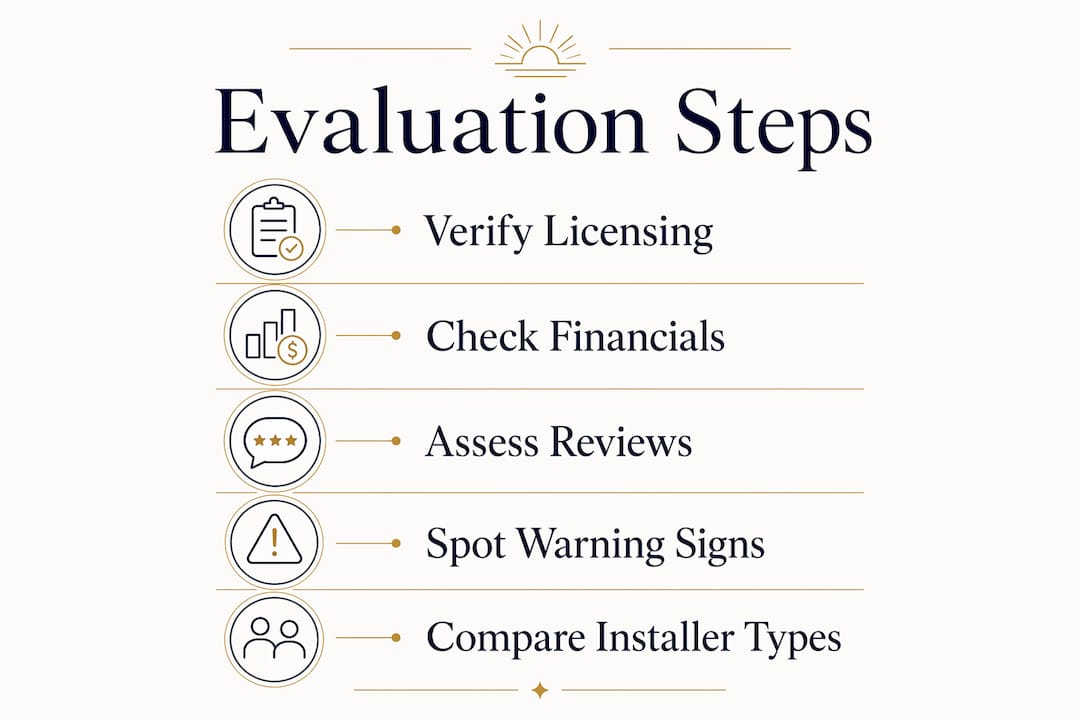
Use multiple platforms to build a complete picture. Google Reviews, Yelp, the Better Business Bureau, and Nextdoor each attract different types of reviewers. A company with 200 five-star Google reviews but zero presence on Nextdoor, where neighbors talk candidly, deserves a closer look.
Watch for these red flags in review patterns:
- Every review is five stars with no specific details about the installation process or crew behavior.
- Complaints cluster around the same issue, such as poor communication after installation or warranty claims being ignored.
- The company responds to negative reviews with hostility or dismissal rather than resolution.
- Reviews spike suddenly over a short period, which can indicate purchased or incentivized feedback.
Pro Tip: Search the company name plus “complaint” or “warranty issue” on Google before you read their curated testimonials. You will often find forum threads and neighborhood group posts that tell a more honest story.
Ratings often show extremes, so the most reliable signal is documented warranty handling and responsiveness to problems. Ask the company directly for two or three references from installations completed three or more years ago. Then call those homeowners and ask specifically whether the company returned to fix any issues and how quickly they responded.
What warning signs should you watch for in solar companies?
The most dangerous solar company is not the one with bad reviews. It is the one with no reviews because it just rebranded from a company that had terrible ones. This practice is called phoenixing, and it is more common than most homeowners realize.
Phoenixing occurs when a company intentionally shuts down to escape warranty obligations and reopens under a similar name with the same ownership. The tell is in the director history. Search the company’s principals through your state business registry and look for their names attached to multiple dissolved companies. One dissolved company is not unusual. Three or four is a pattern.
Here are the most critical warning signs to watch for when you research solar installation companies:
- Less than 5 years of verifiable operation. Short operating history means the company has not survived a full warranty cycle.
- Frequent name changes or rebranding. Check for prior business names in state filings.
- No physical address or local office. A company with only a call center and no local presence cannot service your system efficiently.
- Unusually low quotes. Extremely cheap quotes almost always indicate corner-cutting on installation quality or hidden costs that surface later.
- Vague warranty terms. If the warranty document does not specify who services the claim and within what timeframe, it is not a real warranty.
A 25-year warranty is only valuable if the company remains financially stable and exists to honor it. Company longevity and financial health are the single most critical factors for warranty reliability.
The price trap is where most homeowners make their biggest mistake. A quote that is 20% below every competitor is not a deal. It is a signal that something in the equipment, labor, or business model is being cut to make that number work.
Local NABCEP installers vs. national solar chains: which is better?
The choice between a local certified installer and a national solar brand affects more than price. It affects who shows up when your system has a problem in year 8.
Local NABCEP-certified installers generally outperform national chains in installation quality and warranty responsiveness. They typically use in-house crews, which means the same people who installed your system are the ones who come back to service it. National chains frequently subcontract installations to third-party crews who have no ongoing relationship with your home or your warranty.
| Factor | Local NABCEP Installer | National Chain |
|---|---|---|
| Installation crew | In-house, consistent | Often subcontracted, variable |
| Pricing | Typically 10–20% lower overhead | Higher due to national marketing costs |
| Warranty service | Direct, faster response | Routed through call centers |
| Local knowledge | Strong (permits, HOA, utility rules) | Inconsistent by region |
| Long-term stability | Tied to local reputation | Subject to corporate restructuring |
National brands carry significant marketing overhead, and that cost lands in your quote. A local installer with 10 or more years of operation and a full NABCEP-certified team often delivers better workmanship at a lower price because their business depends entirely on local word-of-mouth.
Pro Tip: Ask any installer what percentage of their installations are completed by their own employees versus subcontractors. If the answer is anything other than 100% in-house, ask for specifics on how subcontractor quality is managed and who handles warranty claims.
The in-house crew advantage extends beyond installation day. When a local company employs its own technicians, accountability is direct. There is no subcontractor to blame and no third-party service ticket to wait on.
Step-by-step checklist to assess solar company reputation
A structured process prevents you from being swayed by a polished sales presentation. Work through these steps before you accept any quote or sign any contract.
- Verify the incorporation date through your state’s official business registry. Confirm it matches what the company claims on its website.
- Check the state contractor’s license for active status and any disciplinary actions. In California, use the CSLB online license check.
- Confirm NABCEP certification for at least one team member through the NABCEP public directory.
- Read reviews across Google, Yelp, and BBB. Look for patterns in complaints, not just the star average.
- Search director names in the state business registry to check for prior dissolved companies.
- Request references from installations completed 3 or more years ago and call them directly.
- Compare at least three quotes and flag any that are significantly below the others.
- Read the warranty document in full. Confirm who services the claim, what the response time is, and whether the warranty transfers if you sell your home.
| Evaluation Step | Verification Method | Dealbreaker Threshold |
|---|---|---|
| Years in operation | State business registry | Less than 5 years |
| License status | State licensing board | Inactive, suspended, or expired |
| Review volume and quality | Google, Yelp, BBB, Nextdoor | Fewer than 100 reviews or below 4.0 stars |
| Director history | State business registry | Multiple dissolved companies |
| Quote pricing | Compare 3+ bids | Outlier low bids without explanation |
Walk away immediately if a company pressures you to sign the same day, refuses to provide references, or cannot produce a written warranty document on request. These are not negotiating tactics. They are dealbreakers.
Key takeaways
A solar company’s track record is only as reliable as the verifiable evidence behind it, and checking credentials, reviews, and financial stability before signing protects your investment for decades.
| Point | Details |
|---|---|
| Verify years in operation | Use state business registries to confirm actual incorporation dates, not website claims. |
| Prioritize NABCEP certification | Certified in-house crews deliver better quality and faster warranty service than subcontracted teams. |
| Check reviews across platforms | Look for 100+ reviews with a 4.0–4.5 star average on Google, Yelp, and BBB combined. |
| Watch for phoenixing | Search director names in state registries to detect companies that dissolved and relaunched to avoid warranty debts. |
| Never choose on price alone | Outlier low quotes signal corner-cutting on equipment or labor that creates costly problems later. |
What 30 years in san diego taught me about vetting solar companies
I have watched the San Diego solar market go through multiple cycles since the mid-1990s. Companies launch during incentive booms, collect deposits, and disappear when the economics shift. The homeowners left behind are not just out money. They are holding systems with no warranty support and no one to call.
The pattern I see most often is homeowners who did everything right except verify the company’s actual operating history. They read the reviews, they liked the salesperson, and they chose the lowest quote. Three years later, they are calling us to repair work done by a company that no longer exists.
The uncomfortable truth about solar company evaluation is that financial stability matters more than any single credential. A company’s financial health is the single most critical factor for warranty reliability, because no warranty means anything if the company closes before you need it. I would rather see a homeowner choose a company with a slightly higher quote and 15 years of verified local operation than a slick national brand with aggressive pricing and a three-year track record.
My recommendation is always to prioritize verifiable evidence over sales presentations. Ask for the incorporation date. Call the references. Search the owner’s name in the state registry. A company with nothing to hide will answer every one of those questions without hesitation. One that deflects or rushes you to sign is showing you exactly who they are.
— David
Why san diego homeowners trust Sandiegosolar after 30 years
Sandiegosolar has operated continuously in San Diego County since 1996, making it the longest-running residential solar installer in the region. Every installation is completed by a 100% in-house crew with zero subcontractors, which means the same team that installs your system is the team that services it under warranty.
Sandiegosolar’s solar installation services include custom system design, full permitting, SDG&E interconnection, and written project timelines before you commit. NABCEP-certified technicians handle every job, and manufacturer warranties up to 25 years are backed by a company that has outlasted every industry shakeout in California. You can also review completed projects across San Diego to see the quality of work firsthand. Request a free consultation and get transparent pricing with no pressure to sign on the spot.
FAQ
How many years should a solar company be in business?
Experts recommend a minimum of 5 years of continuous operation, with 10 or more years preferred for warranty reliability. Longer operating history means the company has survived industry downturns and fulfilled real warranty claims.
What is NABCEP certification and why does it matter?
NABCEP stands for North American Board of Certified Energy Practitioners. It is the most recognized professional credential in the solar industry, confirming that installers meet rigorous technical and ethical standards.
How do i spot fake solar company reviews?
Look for reviews that are exclusively five stars with no specific details, or that spike suddenly over a short period. Cross-check the company on Google, Yelp, BBB, and Nextdoor to identify patterns that a single platform would not reveal.
What is solar company phoenixing?
Phoenixing is when a company intentionally closes to escape warranty debts and reopens under a new name with the same ownership. Search the company’s principals in your state business registry to check for prior dissolved companies.
Should i always choose the lowest solar quote?
No. Extremely cheap quotes typically indicate corner-cutting on installation quality, lower-grade equipment, or hidden costs that appear after installation. Compare at least three bids and investigate any outlier that is significantly below the others.